
Don't Get on Your Child's Emotional Roller Coaster Ride
Nov 04, 2026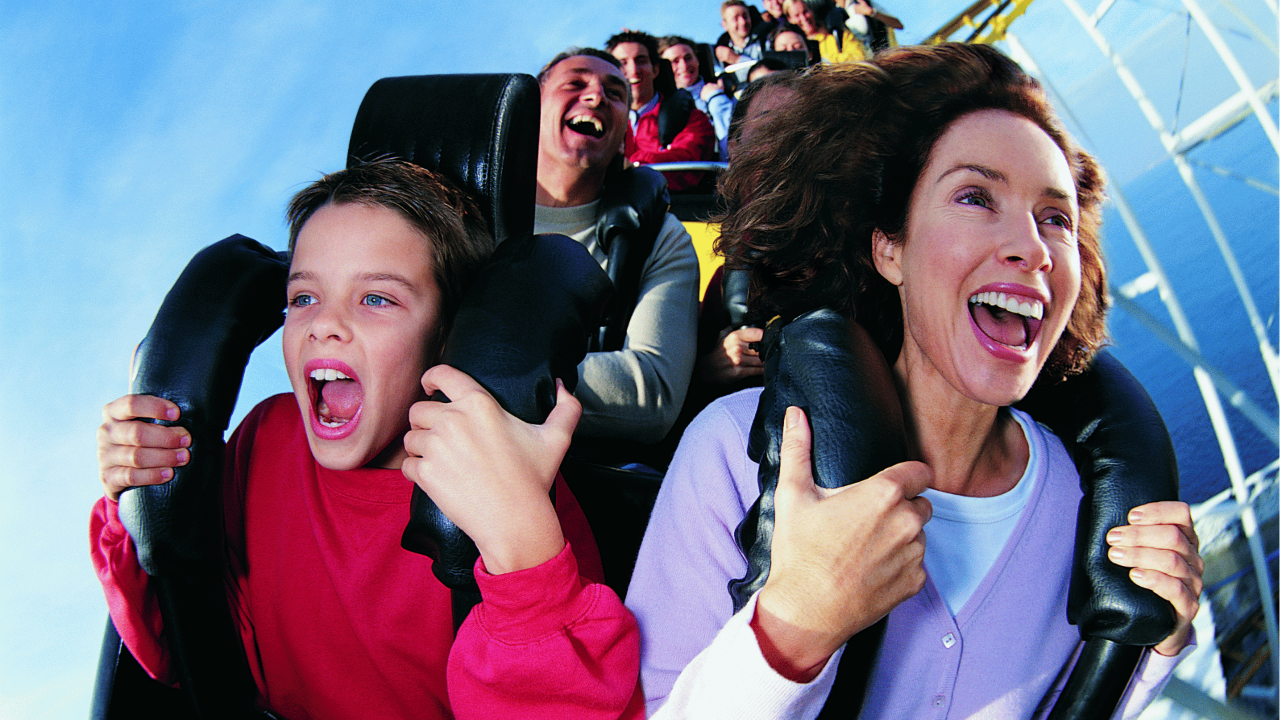
Why being an emotionally regulated parent doesn't mean always being calm
Years ago, I attended a parent orientation at my child's high school, and the presenter shared an image that has stayed with me ever since. She said something along the lines of:
“Your adolescent is going to be on an emotional roller coaster over the next several years. Your job as a parent is not to climb into the seat next to them.”
I remember how powerfully that landed for me. Because isn't that exactly what we so often do as parents? Our child becomes frustrated, and suddenly we're frustrated. They're anxious, and we become anxious. They're angry, and before we know it, we're matching their intensity, raising our voices, and getting swept up in the very emotional storm we're supposed to be helping them navigate.
Without even realizing it, we've climbed aboard their roller coaster. And now, instead of one dysregulated person, we have two. That image has followed me throughout my parenting journey. It has also become one of the most important reminders I return to when my children's emotions threaten to pull me into their orbit.
Becoming the steady parent hasn't come naturally to me
I'll be the first to admit that learning to remain emotionally grounded in the face of my children's big emotions has not been easy. I'm a highly empathetic person. I feel things deeply, and I'm particularly sensitive to the emotional states of those around me. When someone I love is distressed, frustrated, or agitated, I can feel that energy in my own body. And when that someone is my child? Well, let's just say that staying off the emotional roller coaster has required a tremendous amount of intention and practice.
This is not something I mastered overnight. It has taken years of learning to recognize my own internal activation, developing tools to create emotional separation, and practicing how to stay present and responsive without becoming emotionally entangled. But recently, I had a moment that reminded me just how far I've come.
“You've become a Zen ninja of emotional regulation.”
My oldest daughter, now 22, was home for a few weeks this summer. One afternoon, she witnessed an interaction between me and my youngest daughter that, in earlier years, might have gone very differently. My youngest was quite literally bouncing off the walls. She was overflowing with energy, poking at her older sister to get a reaction, creating messes everywhere she went, and leaving what felt like a trail of noise, chaos, and shrapnel in her wake.
It was a LOT. And I'll be honest, my internal system was feeling pretty activated. But instead of matching her energy with my own frustration, I did something different. I connected with her. I found something humorous we could share, engaged with her warmly, and then gently redirected all that energy toward something more productive.
In this case, that meant helping her transition outside to the trampoline, where she could jump, move, and release some of that pent-up energy in a way that met her needs without negatively impacting everyone around her. The whole interaction was remarkably uneventful. And that's precisely what made it remarkable. Afterward, my oldest daughter looked at me and said:
“You've become a Zen ninja of emotional regulation.”
I laughed. And then I told her something important. She was absolutely right that I had become much better at managing my own emotional responses. But what she had just witnessed was not effortless calm. It was the result of years of intentional practice.
I reminded her that this hadn't always been easy for me, especially when she and her siblings were younger. And I explained what had actually been happening beneath the surface during that interaction.
What my daughter couldn't see
While I appeared grounded and unruffled on the outside, I had noticed my own irritation beginning to rise. The noise, the movement, the mess, the poking at her sister. All of it was activating my nervous system. But rather than allowing that activation to dictate my response, I used a few simple tools that have become second nature to me.
First, I took a deep breath.
Not because one breath magically eliminates frustration, but because it creates a moment of space between what I'm experiencing and how I choose to respond.
Next, I imagined a bubble surrounding me.
This is one of my favorite visualization tools. I picture an invisible boundary separating my emotional experience from my child's. Her energy belongs to her. My emotional state belongs to me. I can recognize what she's feeling without absorbing it. I can be compassionate without becoming overwhelmed.
I can stay connected without becoming emotionally entangled.
Then, I reminded myself of what was actually happening.
My child wasn't trying to make my life miserable. She was expressing a need. Her body was seeking movement, stimulation, and an outlet for all that energy. And finally, I returned to a simple guiding principle:
Do no harm.
My job wasn't to punish her for having too much energy or make her feel ashamed of how she was expressing it. My job was to step into my nurturing alpha role, recognize what she needed, and help guide her toward a more appropriate way to meet that need. All of this happened internally, in a matter of seconds. My daughter saw a calm, confident response. What she didn't see was the intentional work happening underneath it.
There's a name for this: Detached Engagement
Detached engagement is a powerful tool I teach parents who find themselves getting pulled into their children's emotional storms. And I want to be clear about something.
Detached engagement does not mean emotionally detaching from your child.
Quite the opposite. It means remaining emotionally available, connected, and responsive while maintaining a healthy separation between your child's emotional experience and your own. You don't have to feel everything your child feels. You don't have to match their intensity. And you certainly don't have to climb aboard their emotional roller coaster to prove that you care.
You can stand firmly on the platform, offering the steady, reassuring presence they need. In fact, that's often far more helpful.
But here's where I think we get emotional regulation wrong
Somewhere along the way, many parents have come to believe that being emotionally regulated means always being calm. Always speaking softly. Never raising your voice. Never expressing frustration. But emotional regulation is not the same thing as perpetual calm.
It's the ability to respond to a situation with an appropriate level of emotional intensity, rather than being driven by an automatic, reactive response. Sometimes, that absolutely looks like remaining calm. When your child is melting down because you've said no to another cookie, their disappointment doesn't require you to become equally upset. Your grounded presence can help them move through their frustration without adding more emotional fuel to the fire.
But imagine a different scenario. Your child is running toward a busy intersection, completely unaware of the approaching traffic. Are you going to calmly and softly say, “Sweetheart, I'd really appreciate it if you could stop running”? Of course not! You're going to yell, “STOP!”
Your voice will be loud. Your body language will be commanding. Your response will carry urgency. And that can be a perfectly regulated response. Or imagine two siblings fighting, grabbing each other, and pulling hair. A strong, authoritative response might sound like:
“STOP. It is not okay to hurt each other. We're separating right now.”
That isn't emotional dysregulation. That's leadership. That's a parent recognizing what the situation requires and responding accordingly. The important distinction isn't whether your voice is soft or loud.
It's whether you're responding intentionally to the needs of the moment or reacting from your own emotional overwhelm.
Your child doesn't need you to be a Zen master
Despite my daughter's flattering assessment, I am certainly not a Zen master. I still experience frustration. I still get overstimulated. There are still moments when my children's behavior activates something in me. The difference is that I've become much better at recognizing what's happening internally before it spills out into my parenting.
And that is what I want other parents to understand. You don't need to eliminate your emotional responses. You don't need to become someone who is never irritated, overwhelmed, or frustrated. You need to develop the awareness and tools that allow you to experience those emotions without letting them take over. Because when our children are struggling emotionally, they need someone who can remain grounded enough to lead.
Sometimes that leadership looks soft and gentle. Sometimes it looks firm and commanding. But it always comes from the same place: a parent who is taking responsibility for their own emotional state rather than handing that responsibility over to their child. And that brings me back to the roller coaster. Your child is going to have emotional ups and downs. Some seasons will be more intense than others.
You cannot prevent every twist, turn, or sudden drop. But you can practice staying off the ride. You can remain close enough to offer connection, guidance, and reassurance without getting swept up in every emotional surge. And the more you practice, the more natural it becomes. Not because you've stopped feeling things.
But because you've learned that you can feel something strongly without having to act from that feeling. That is emotional regulation. And it's one of the greatest gifts we can offer our children.
A little something to try this week
The next time your child's behavior begins to activate you, see if you can pause long enough to ask yourself three questions:
- What's happening inside me right now? Notice your frustration, tension, urgency, or anxiety without judging yourself for it.
2. What belongs to my child, and what belongs to me? Imagine that invisible bubble helping you remain connected without absorbing their emotional state.
3. What does this situation actually require from me? A soft voice? A firm boundary? A strong intervention? A little humor? Some space to move?
You don't have to get it right every time. Remember, parenting is not a performance. It's a relationship in which we have countless opportunities to practice, grow, and become the steady leaders our children need.
Let's work together! I provide 1:1 support for parents motivated to make positive changing in their parenting and gain confidence and increase fulfillment in their role as parents. If this sounds like it might be what you've been looking for, book a free consultation today.
Stay connected with news and updates!
Join our mailing list to receive the latest news and updates from The 3D Parent.

